
What is a busbar bending machine?
Busbar bending machine is a precision industrial device specifically designed for processing copper and aluminum busbars ( copper vs. aluminum busbars). It is primarily used in the manufacturing of high and low voltage switchgear, transformers, electrical boxes, and other complete sets of power equipment.
In the power industry, busbars are typically thick and rigid metal strips, making manual bending nearly impossible to guarantee precision. A busbar bending machine, however, can precisely bend these metal strips into various shapes (such as L-shapes, Z-shapes, and U-shapes) like origami.
Busbar bending may seem simple, but it is actually a precise process of plastic deformation of metal. The size of the bending radius (R angle) and the accuracy of springback compensation directly determine the structural strength, assembly precision, and electrical safety clearance of the busbar.
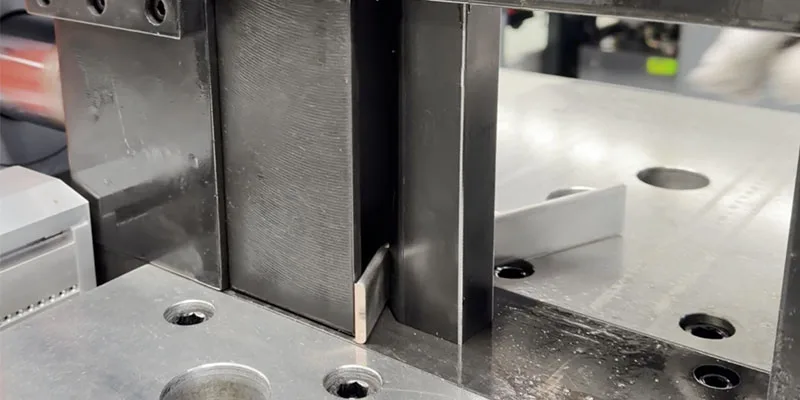
Factors affecting bending radius (R angle)
The radius of the bend in the busbar is called the radius of the rounded corner.
1. Impact on the Integrity of Raw Material Copper Busbar
-
Insufficient R-angle (Acute Angle Bending): The outer fibers of the busbar will be subjected to extreme tensile stress, making them highly susceptible to microcracks or even breakage. For copper busbars, this increases resistivity and reduces mechanical strength.
-
Insufficient R-angle: While protecting the material, this results in an excessively large bending area, affecting the busbar’s layout within compact cabinets (such as low-voltage withdrawable switchgear).
-
Standard Reference: Generally, the R-angle should be no less than **0.5 to 1.5 times** the busbar thickness T (depending on the material’s hardness state, such as Y2 semi-hard copper busbars).
2. Impact on Conductive Cross-sectional Area
Due to the thinning effect of stretching at the bend, the actual conductive cross-sectional area will decrease slightly. If the R angle is not properly controlled, it will cause excessive stretching on the outside, which will cause local heat generation (excessive temperature rise), especially when carrying large currents (such as above 2000A).
Mechanism of springback compensation
When the bending die of the bending machine is depressed, the busbar will try to return to its original shape due to the elasticity of the metal, resulting in an actual bending angle greater than the angle pressed down by the bending die.
1. Key Variables Affecting Springback
- Material Properties: Aluminum busbars typically exhibit greater springback than copper busbars; for the same material, hard springback is more pronounced than soft springback.
- Bending Radius R: The larger the R/T (radius to thickness ratio), the wider the area involved in elastic deformation, and the more significant the springback.
- Thickness Tolerance: Even small fluctuations in the busbar thickness can significantly alter the bending modulus. For example, a 10 mm copper busbar with a thickness error of only 0.2 mm may result in a springback angle deviating by more than 0.5 rpm.
2. Springback Compensation Control Methods
To achieve a final 90° bend, the die must be pressed to a deeper angle than 90° (e.g., 93°).
-
Empirical Coefficient Method: Pre-set fixed compensation values based on material and thickness. Suitable for simple processing of single batches and specifications.
-
Real-time angle detection (closed-loop control): The advanced CNC busbar bending machine uses sensors to measure the angle in real time during the pressing process. After pressure is released, the system immediately detects the residual springback angle and performs “secondary pressure compensation” if necessary.
Tips: The video below demonstrates the electronic automatic springback compensation bending die of the SUNSHINE NC40.ZB-1200 CNC busbar bending machine, allowing you to more intuitively understand the springback compensation mechanism.
The relationship between the R angle and springback
These two factors are not independent but rather mutually restrictive:
- The larger the radius (R) angle, the more difficult it is to predict springback: When bending at a large radius angle, the material undergoes relatively less plastic deformation, resulting in stronger elastic recovery.
- Die wear: As the radius angle die wears, the contact stress distribution changes, leading to altered springback patterns and a decrease in accuracy.
Summary and Recommendations
| Factors | Impact on Results | Optimization Recommendations: |
|---|---|---|
| R-angle setting | Mechanical fatigue, cracks, electrical resistance. | Strictly adhere to R>=1.0T (for hard copper busbars). |
| Springback compensation | Assembly clearances, busbar layout consistency. | Use a servo bending machine with automatic angle feedback. |
| Mold matching | Surface indentations, angular accuracy. | Ensure the die opening width (V-groove) matches the R angle; typically V = 6~8T. |